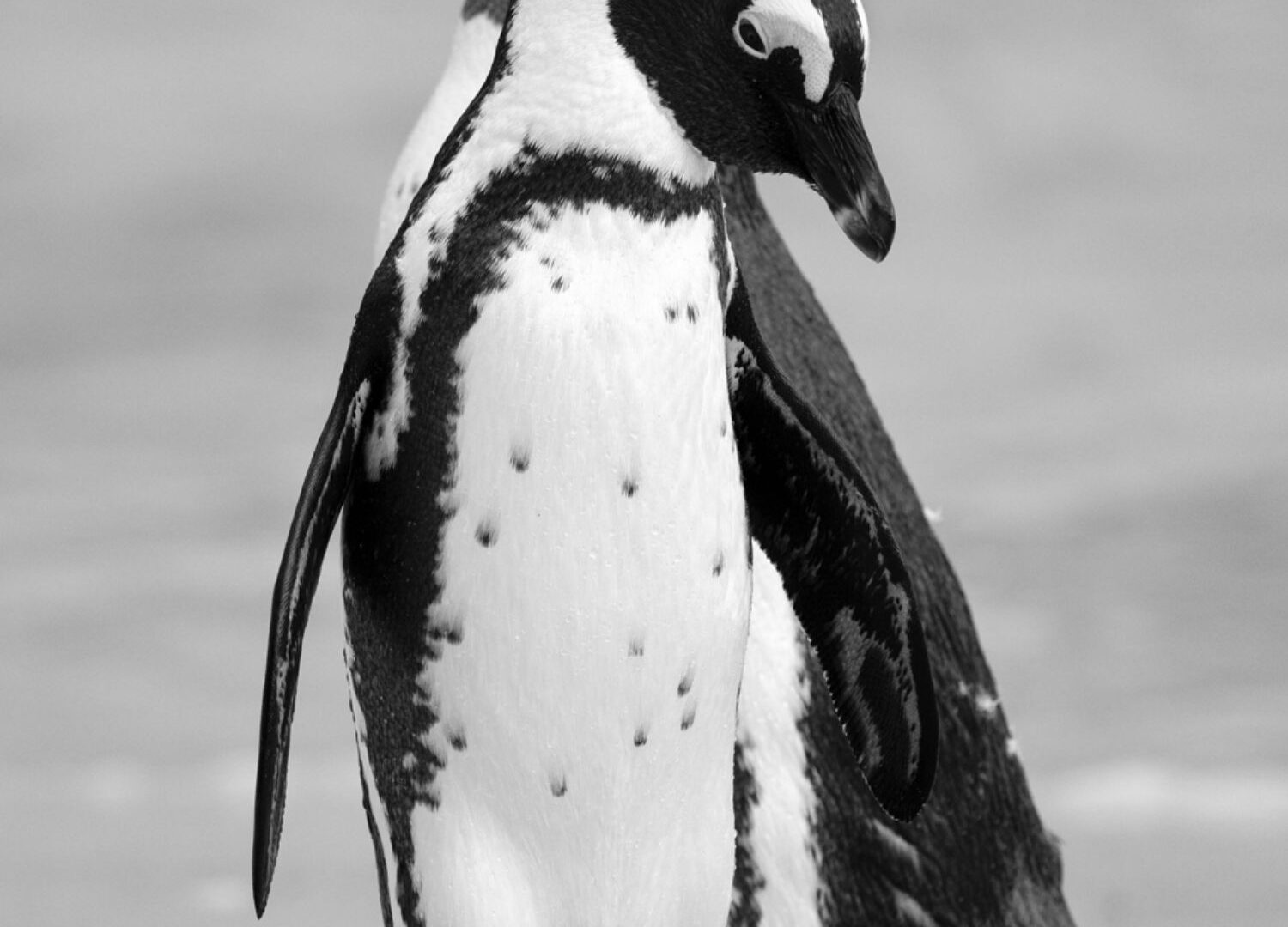
As African penguins are pushed towards extinction due to competition with commercial purse-sein fisheries, climate change and human activity, a landmark legal battle has reached a historic agreement to save these iconic seabirds. Iga Motylska speaks to The Southern African Foundation for the Conservation of Coastal Birds (SANCCOB) to learn what’s needed next.
ONE OF MY FONDEST CHILDHOOD memories was admiring the African penguin colony at Boulders Beach when I was about six years old. A family holiday photo shows me dressed in my favourite Mickey Mouse matching t-shirt and trousers set with a paper Spur hat on my head, crouching near an African penguin with the widest smile pasted across my face. I cannot imagine that in the not-so distant
future, other children might not have the opportunity to see an African penguin in the wild.
It is a reality with which we have had to grapple, as the global population of African penguins fell
below 10,000 breeding pairs in 2023, seeing them reclassified as ‘Critically Endangered’ by the IUCN (The International Union for Conservation of Nature).
Since the time that family photo was taken, some three decades later, the African penguin population in South Africa alone has decreased by over 76%. The aquatic bird has already lost 97% of its population. At
their current rate of decline, African penguins stood an extremely high risk of extinction in the wild by 2035 – if nothing were to change – according to a recent study by Dr Richard Sherley.
Unlike the Black and White rhino, which faces threats from organised crime and poaching syndicates, African penguin numbers are dwindling due to poorly regulated fishing practices and human activity (such as habitat degradation, pollution and noise), combined with climate change.
African penguins compete for food with intense commercial purse-seine fishing that uses large nets to
catch huge quantities of small pelagic fish near their breeding colonies. This means that the penguins need to swim much further to find food, resulting in increased energy expenditure and reduced reproductive success.
The (now named) Department of Forestry, Fisheries and the Environment (DFFE) published the Biodiversity Management Plan for African penguins in 2013, to manage these threats. The government department implemented fishing closures in 2024, however, the South African Foundation for the Conservation of Coastal Birds (SANCCOB) argued that these were inadequate in size and would not reduce competition for available food sources with the fishing industry. SANCCOB and BirdLife South Africa took then South African government is to take the case to court in March 2024 to review these fishing closures.
“We advocated for island closures or no-take zones to commercial fisheries around six of the most important African penguin breeding colonies to secure their food availability, specifically for sardine and anchovy to be managed sustainably, so it serves for human purposes and marine species that rely on these fish,” says Nicky Stander, Head of Conservation at SANCCOB.
Earlier this year, a historic settlement agreement was reached between the government, pelagic fishing industry and conservation organisations on significantly improved year-round closures for several penguin colonies.
These will remain in place for 10 years, with a review after six.
St Croix Island (Algoa Bay) has a slightly improved closure area; Bird Island (Algoa Bay) will have a 20km closure radius; Dassen Island (West Coast) will retain the interim closure under previous
permit conditions; Robben Island (West Coast) will have a 20km fisheries exclusion zone consistent with the initial Island Closure Experiment conducted a decade ago; Stony Point (Betty’s Bay) will have a new closure to all fishing vessels; and Dyer Island (Gansbaai) will retain previous permit conditions.
2025 also saw the government publish draft regulations for public comment around bunkering (ship-to ship at-sea refuelling) in Algoa Bay, which has caused four oil spills, while the increased vessel traffic dramatically alters the underwater soundscape to which marine species are extremely sensitive. The legal action was not just about protecting penguins, but also about safeguarding South Africa’s ecological and economic interests. Not only do penguins support marine biodiversity in their facilitative role for other marine predators that feed on pelagic shoaling fish, but they also fertilise ecosystems around their colonies and are an indicator species of ocean health.
The tourism value of African penguins is estimated to be between R1.9 billion – R4.5 billion, according to a 2023 socio-economic report by DFFE and Endangered Wildlife Trust (EWT). “Boulders Beach is the third most visited tourist attraction in Cape Town, after the V&A Waterfront and Table Mountain. Many people come to Cape Town specifically to see Africa’s only penguin species,” says Stander. “Most of that value comes from the tourism value of the colonies, which attracts visitors and local spending on accommodation, restaurants, gift shops, and this figure also includes their existence value,” she adds.
Much still needs to be done in the next decade, and beyond, to help turn the tide, so that these beloved seabirds do not become a fading photograph in a family album.
HOW YOU CAN HELP AFRICAN PENGUINS
Non-profit SANCCOB rescues, rehabilitates and releases about 2,000 African penguins and other seabirds each year across their two seabird hospitals in the Western and Eastern Cape. They help conservation authorities monitor wild African penguins, rescue birds in need, artificially incubate rescued or abandoned penguin eggs and raise chicks for release into the wild, educate the public, and advocate for policy change at the government level. You can support them in various ways: https://sanccob.co.za/ get-involved/.
Respect responsible tourism guidelines that minimise disturbances to
penguins.
Book a daily tour at SANCCOB’s Table View or Gqeberha visitor centres (R60/adult, R40/senior, children (up to 12) R50, toddlers (up to 3) free).
‘Adopt’ a penguin for a year (R600) or support a resident home pen bird that cannot be released into the wild (R1000), or fund the rearing of a penguin egg (as part of the nesting programme) that will be
released into the wild (R300).
Volunteer or sign up for a mentored training programme: in Cape Town or Gqeberha.
Donate to SANCCOB or BirdLife South Africa to support their work.